Works of
David Chancellor, Giulia Degasperi, Aleksey Kondratyev
Curated by
Steve Bisson
Orari
Sunday 4:30pm–7:30pm
Lab27 opens its 2025 season on Friday, February 7 at 9 PM with the exhibition “Sei un animale (You Are an Animal),” offering glimpses into our relationship with heterotrophic life forms and those closest to the human species.
For the first time, a selection of works by photographer David Chancellor—one of the most dedicated and perceptive observers of African wildlife—are brought together in a single show. The exhibition also includes works by Giulia Degasperi from her long-term documentary project on pastoral life in the Trentino Alps, as well as a series of portraits of Kazakh fishermen by Kyrgyz photographer Aleksey Kondratyev.
Humanity’s gaze—now also through the lens of photography—has always been fixed on nature. The earliest cave paintings depict animals, often in scenes of hunting. The etymology of the word “animal” contains anima, the vital breath, the spirit that organically connects us to the world and brings existence to life. An animal is a living being, and therefore humans too may be considered animals—though not in a “zoo,” a Greek-derived term meant to separate rather than unite. It is precisely this intellectual division—this line that distinguishes the individual from other life forms—that has fueled an anthropocentric culture, placing humans at the top of the organic pyramid and reducing other beings to raw materials, canned meat, or other consumable forms.
It is in this context that “animal” becomes an adjective—at times even a slur—meant to reinforce this human supremacy. Yet this supposed dominance is increasingly questioned by those who see, in the frequent afflictions of our “respiratory tract,” in that tormented anima, signs of a deeper human malaise. The abolition of hunting, animal rights activism, and veganism are just some of the many faces of a growing discontent.
At its core lies a desire to reconfigure our relationships with other life forms—not only those that are zoomorphic—but also to rethink the boundaries of the soul, and the very idea of the “human passport.”

David Chancellor’s work focuses on the conflicting dimensions of wildlife conservation in Africa—a continent that still hosts a rich and spectacular variety of fauna.
His photographs raise a level of interpretive complexity that mirrors the tangled forces at play: poverty and poaching, trophies and paid hunting, tourism and preservation, human pressure, enclosures and natural habitats.
The solution? There is no solution. Coexistence with animal species lies in the ongoing search for balance—or more accurately, compromise. This precarious “tightrope walk” that defines conservation policy often involves controversial measures.
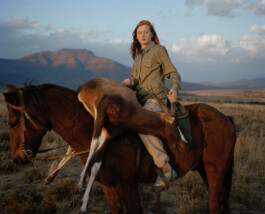
One particularly emblematic image is the portrait of 12-year-old Josie, a young hunter from Alabama, posed on horseback like a modern-day Diana, proudly holding the antlers of her prey. Paid hunting—resembling a kind of “pay-per-view” service reimagined as “pay-and-shoot”—allows the user to “target” what’s necessary, while enabling the host to generate funds: money that can go toward purchasing vital equipment for park rangers or providing protein for local village communities.


A disenchanted vision of the fragile, peripatetic human condition—entropically wandering in search of food and shelter—is revealed in Aleksey Kondratyev’s series dedicated to the practice of ice fishing in Kazakhstan. Across the flat, frozen expanses of the Ishim River, anthropomorphic figures endure sub-zero temperatures in hopes of tricking a fish or two. It’s a scene of primal hunger, subsistence living, and the bare instinct for survival. And yet, this same river now runs through a futuristic capital, built from scratch thanks to oil reserves, access to global markets, and the architectural boldness of the post-Soviet era. But the photographer doesn’t state any of this outright—he lets it emerge quietly through the plastic packaging sheets, from who-knows-where, that the intrepid fishermen use to shield themselves from -40°C temperatures. Here, globetrotting capitalism intersects with snapshots of frozen, Paleolithic human cocoons—betrayed only by their tools, and by their increasingly inescapable dependence on things.


Giulia Degasperi embarks on a journey that is not only a tribute to her Trentino roots but also an exploration of a common inner conflict—the oscillation between the rhythms of nature and those of the city.
After moving to Berlin, the photographer chooses to return to the mountains to capture the lives of people who live and work at high altitudes. This is the premise of her documentary These Dark Mountains, and of the many questions posed by those seeking escape from contemporary society.
Among the Alpine peaks, Giulia explores the dreams and hopes of those who follow the age-old practice of alpeggio—the seasonal movement of livestock—contributing to the maintenance of one of Europe’s most biodiverse and species-rich landscapes. Over the course of two years, she visits various barns and farms to document the solitude and extraordinary labor required to sustain a life lived outdoors: amid steaming dung, starry skies, and direct contact with animals and nature. A life of elemental exchanges—indispensable and yet precarious.
Beyond ecological idealism, into the wild aesthetics, mythopoetic romanticism, and other naturalist tendencies, what the human mind thinks—remains human.
The nature within and around us thinks and acts in its own way: sometimes in our favor, as in digestion; other times, by dropping the sky on our heads. We are part of it all, for better or worse—made of the same ingredients, mixed differently.
To observe animals—or those life forms that have evolved apart from us—and to listen to their breathing, helps us to recognize a shared soul, a vital force that manifests in an extraordinary, curious richness and diversity of forms.
Surely, it’s not the only one in the universe. But for now, it is growing harder to find—while from among our kind, it quietly slips away, still allowing itself to be photographed.


Works of
David Chancellor, Giulia Degasperi, Aleksey Kondratyev
Curated by
Steve Bisson
Orari
Sunday 4:30pm–7:30pm
Lab27 opens its 2025 season on Friday, February 7 at 9 PM with the exhibition “Sei un animale (You Are an Animal),” offering glimpses into our relationship with heterotrophic life forms and those closest to the human species.
For the first time, a selection of works by photographer David Chancellor—one of the most dedicated and perceptive observers of African wildlife—are brought together in a single show. The exhibition also includes works by Giulia Degasperi from her long-term documentary project on pastoral life in the Trentino Alps, as well as a series of portraits of Kazakh fishermen by Kyrgyz photographer Aleksey Kondratyev.
Humanity’s gaze—now also through the lens of photography—has always been fixed on nature. The earliest cave paintings depict animals, often in scenes of hunting. The etymology of the word “animal” contains anima, the vital breath, the spirit that organically connects us to the world and brings existence to life. An animal is a living being, and therefore humans too may be considered animals—though not in a “zoo,” a Greek-derived term meant to separate rather than unite. It is precisely this intellectual division—this line that distinguishes the individual from other life forms—that has fueled an anthropocentric culture, placing humans at the top of the organic pyramid and reducing other beings to raw materials, canned meat, or other consumable forms.
It is in this context that “animal” becomes an adjective—at times even a slur—meant to reinforce this human supremacy. Yet this supposed dominance is increasingly questioned by those who see, in the frequent afflictions of our “respiratory tract,” in that tormented anima, signs of a deeper human malaise. The abolition of hunting, animal rights activism, and veganism are just some of the many faces of a growing discontent.
At its core lies a desire to reconfigure our relationships with other life forms—not only those that are zoomorphic—but also to rethink the boundaries of the soul, and the very idea of the “human passport.”

David Chancellor’s work focuses on the conflicting dimensions of wildlife conservation in Africa—a continent that still hosts a rich and spectacular variety of fauna.
His photographs raise a level of interpretive complexity that mirrors the tangled forces at play: poverty and poaching, trophies and paid hunting, tourism and preservation, human pressure, enclosures and natural habitats.
The solution? There is no solution. Coexistence with animal species lies in the ongoing search for balance—or more accurately, compromise. This precarious “tightrope walk” that defines conservation policy often involves controversial measures.
One particularly emblematic image is the portrait of 12-year-old Josie, a young hunter from Alabama, posed on horseback like a modern-day Diana, proudly holding the antlers of her prey. Paid hunting—resembling a kind of “pay-per-view” service reimagined as “pay-and-shoot”—allows the user to “target” what’s necessary, while enabling the host to generate funds: money that can go toward purchasing vital equipment for park rangers or providing protein for local village communities.

A disenchanted vision of the fragile, peripatetic human condition—entropically wandering in search of food and shelter—is revealed in Aleksey Kondratyev’s series dedicated to the practice of ice fishing in Kazakhstan. Across the flat, frozen expanses of the Ishim River, anthropomorphic figures endure sub-zero temperatures in hopes of tricking a fish or two. It’s a scene of primal hunger, subsistence living, and the bare instinct for survival. And yet, this same river now runs through a futuristic capital, built from scratch thanks to oil reserves, access to global markets, and the architectural boldness of the post-Soviet era. But the photographer doesn’t state any of this outright—he lets it emerge quietly through the plastic packaging sheets, from who-knows-where, that the intrepid fishermen use to shield themselves from -40°C temperatures. Here, globetrotting capitalism intersects with snapshots of frozen, Paleolithic human cocoons—betrayed only by their tools, and by their increasingly inescapable dependence on things.


Giulia Degasperi embarks on a journey that is not only a tribute to her Trentino roots but also an exploration of a common inner conflict—the oscillation between the rhythms of nature and those of the city.
After moving to Berlin, the photographer chooses to return to the mountains to capture the lives of people who live and work at high altitudes. This is the premise of her documentary These Dark Mountains, and of the many questions posed by those seeking escape from contemporary society.
Among the Alpine peaks, Giulia explores the dreams and hopes of those who follow the age-old practice of alpeggio—the seasonal movement of livestock—contributing to the maintenance of one of Europe’s most biodiverse and species-rich landscapes. Over the course of two years, she visits various barns and farms to document the solitude and extraordinary labor required to sustain a life lived outdoors: amid steaming dung, starry skies, and direct contact with animals and nature. A life of elemental exchanges—indispensable and yet precarious.


Beyond ecological idealism, into the wild aesthetics, mythopoetic romanticism, and other naturalist tendencies, what the human mind thinks—remains human.
The nature within and around us thinks and acts in its own way: sometimes in our favor, as in digestion; other times, by dropping the sky on our heads. We are part of it all, for better or worse—made of the same ingredients, mixed differently.
To observe animals—or those life forms that have evolved apart from us—and to listen to their breathing, helps us to recognize a shared soul, a vital force that manifests in an extraordinary, curious richness and diversity of forms.
Surely, it’s not the only one in the universe. But for now, it is growing harder to find—while from among our kind, it quietly slips away, still allowing itself to be photographed.


